Restorative Dentistry · Sacramento, CA
Full & Partial Dentures in Sacramento, CA
Modern dentures look natural, fit comfortably, and restore your ability to eat, speak, and smile with confidence. Whether you need a full set or a partial to complement remaining teeth, we craft each denture for a precise, secure fit.
We also offer implant-supported dentures for patients who want maximum stability with no slipping.
What Are Dentures?
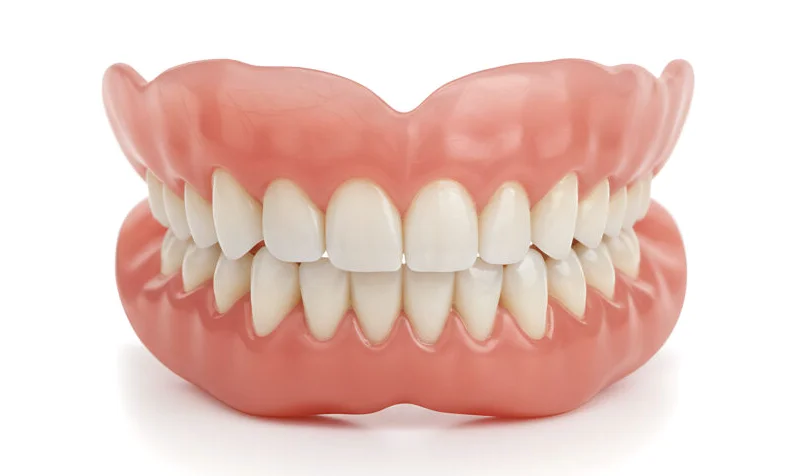
Dentures are custom-made, removable replacements for missing teeth. A full denture replaces an entire upper or lower arch, while a partial denture fills in gaps around your remaining natural teeth. Modern dentures bear little resemblance to the bulky "false teeth" of past generations — today's materials look natural, feel lighter, and fit far more precisely.
Replacing missing teeth restores much more than a smile. Well-fitted dentures bring back comfortable chewing, clearer speech, and support for your lips and cheeks — the facial structure that can look sunken when teeth are gone. For many patients, dentures are also the most budget-friendly way to replace many teeth at once.
At Fulton Family Dental, Dr. Bhumika Kathiriya, DDS crafts each denture individually, refining the fit over a series of visits so it sits securely and comfortably. For patients who want maximum stability, we also offer implant-supported dentures that snap onto a few strategically placed dental implants — no slipping, no adhesive.
When Are Dentures the Right Choice?
Dr. Kathiriya may recommend a full or partial denture when:
- You're missing most or all of the teeth in an arch
- Several remaining teeth are failing and need extraction
- You're missing multiple teeth in different areas, where a single bridge can't reach
- Chewing has become difficult and you're avoiding foods you love
- Missing teeth are affecting your speech or the shape of your face
- An old denture has become loose, uncomfortable, or worn
- You want a complete smile on a practical budget, with the option to upgrade to implant support later
Why Sacramento Families Choose Us for Dentures
Truly Custom Fit
Careful impressions, measurements, and try-in visits mean your denture is built for your mouth — not adapted to it.
Natural Appearance
Tooth shade, shape, and gum contours are chosen with you, so your new smile looks like you.
Adjustments & Relines
We fine-tune the fit after delivery and reline dentures over time as your mouth naturally changes.
UCLA-Trained Dentist
Dr. Kathiriya has fitted dentures for Sacramento families for 16+ years, with honest guidance on every option.
Getting Dentures: What to Expect
-
Consultation & Planning
We examine your mouth, take low-radiation <a href="/digital-x-rays/">digital X-rays</a>, and map out the right plan — full, partial, or implant-supported — with clear costs before anything begins.
-
Impressions & Measurements
Precise impressions and bite measurements capture the exact contours of your gums and how your jaws meet, the foundation of a comfortable fit.
-
Try-In & Design Approval
You preview the denture in wax first — checking the look, fit, and bite together — so we can adjust tooth shade, shape, and position before the final denture is made.
-
Delivery & Fine-Tuning
Your finished denture is fitted and adjusted, and we schedule follow-up visits to smooth any sore spots as you adapt. Small refinements early make a big difference in comfort.
Caring for Your Dentures
With good care, a quality denture typically serves you well for five to ten years. Your gums and jawbone naturally change shape over time, so most dentures need periodic relines to keep the fit snug — and eventually a replacement. Regular checkups let us monitor the fit and the health of your gums and any remaining teeth.
Keep your dentures comfortable:
- Clean your denture daily with a soft denture brush and non-abrasive cleanser — regular toothpaste is too harsh
- Remove your denture at night and soak it in water or denture solution so your gums can rest
- Keep up with regular dental exams so we can check your fit, gums, and any remaining teeth
- See us promptly for a reline if your denture starts to slip or rub — don't rely on ever-thicker adhesive
Denture Cost & Insurance in Sacramento
Denture cost depends on the type — full or partial, conventional or implant-supported — and the materials used. Most PPO dental insurance plans cover dentures as a major procedure, often around 50% after your deductible, and many plans contribute toward replacement dentures at set intervals.
At our Arden-Arcade office we verify your benefits before treatment and give you a clear written estimate, so there are never surprises. Call (916) 929-3737 or book a consultation online — we're happy to compare every option, including implant-supported dentures, side by side. We serve patients in English, Hindi, and Spanish.
Frequently Asked Questions
How long does it take to get used to new dentures?
Most patients adapt within a few weeks. Early on, it's normal to notice extra saliva, minor sore spots, and some awkwardness with speech — all of which fade quickly. Starting with softer foods and reading aloud at home speeds up the adjustment, and we'll smooth out any persistent sore spots at your follow-up visits.
Will I be able to eat normally with dentures?
Yes — with practice, denture wearers eat a wide range of foods comfortably. Start with softer foods cut into small pieces and chew on both sides evenly. If you want the strongest possible bite, implant-supported dentures restore significantly more chewing power than conventional ones.
Should I sleep in my dentures?
We recommend taking dentures out at night. Your gums need time to rest, and soaking the denture overnight keeps it clean and helps prevent irritation and infections like thrush.
What's the difference between a full and a partial denture?
A full denture replaces every tooth in an arch and rests on your gums. A partial denture replaces only the missing teeth, anchoring to your remaining natural teeth with discreet clasps. If you still have healthy teeth, a partial preserves them — and a fixed bridge may also be worth comparing.
How are implant-supported dentures different?
Instead of resting on the gums, an implant-supported denture snaps onto a few dental implants placed in the jaw. The result is a denture that never slips, needs no adhesive, and helps preserve jawbone. If bone has thinned over time, bone grafting can often rebuild the foundation needed.
Can I get dentures right after my teeth are removed?
Often yes — an immediate denture can be placed the same day as your extractions, so you never go without teeth. Because gums change shape as they heal, immediate dentures typically need a reline or replacement after the first several months.
Do I need denture adhesive?
A well-fitted denture should stay secure with little or no adhesive. A thin layer can add confidence, but if you find yourself needing more and more adhesive to keep a denture in place, that's a sign it needs a reline — give us a call.
How long do dentures last?
Typically five to ten years, with periodic relines along the way. Even if your denture still feels fine, yearly checkups matter — we monitor your gum health, screen for oral disease, and catch fit changes before they cause sore spots or bone loss.
More Restorative Dentistry Services
A Complete, Confident Smile
Book a denture consultation and find the right fit for you.